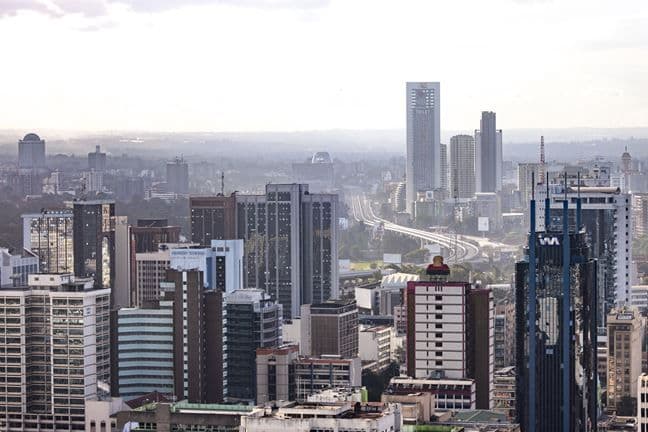
Scroll through Kenyan real estate commentary for ten minutes and you'll hit two completely opposite claims. One says Nairobi is oversupplied, apartment prices are correcting, and buyers finally have leverage. The other says Kenya has a housing deficit measured in millions of units, and demand will outstrip supply for a generation.
Both are true. They're just describing different parts of the same market. Understanding which part you're actually looking at is the whole game here.
The Correction That's Real
Start with what's genuinely happening in the data. HassConsult's Q1 2026 index shows apartment values in Westlands down 2.8% in a single quarter, and Upper Hill down 2.5%, with Upper Hill rents off 5.1% over the year. Across the wider market, ten of eighteen surveyed suburbs and satellite towns recorded annual price declines. KNBS data tells a similar story: the average three-bedroom apartment across Eastlands and the satellite belt slid from around KSh 21 million in 2022 to roughly KSh 18 million by 2025.
The premium apartment corridor has taken the sharpest hit. Westlands, Kileleshwa, and Parklands apartment prices fell somewhere between 7% and 11.5% as oversupply from several years of aggressive construction finally caught up with demand. HassConsult's co-CEO Sakina Hassanali put it plainly: the correction in apartment prices reflects increased supply, moving toward saturation in some areas.
This isn't speculation. It's developers building what was profitable to build, not necessarily what buyers actually wanted.
Why Developers Built the Wrong Thing
Here's the mechanism worth understanding, because it explains the correction better than "too much supply" alone. Land within Nairobi has become increasingly expensive and scarce, which made vertical apartment development far more profitable than standalone houses developers could fit more units, and more revenue, onto the same expensive parcel. Nairobi's growing urban population created genuine demand for apartment living, and for years, that demand justified the pace of construction.
But the segment that got built out fastest mid-market apartments in Westlands, Upper Hill, and parts of Kilimani eventually outpaced the buyers actually looking for that specific product, in that specific price band. The correction isn't really a story about "Nairobi has too much housing." It's a story about Nairobi building disproportionately in one lane while other lanes stayed hungry.
The Deficit That's Also Real
Here's the other half of the picture, and it's not small. Kenya's housing deficit is measured in the millions of units, with annual demand of roughly 250,000 homes against barely 50,000 actually delivered each year. That gap isn't closing it compounds every year it goes unaddressed.
And the segments experiencing genuine shortage are specific: affordable and mid-tier housing, and detached homes in established prime suburbs. There are simply not enough standalone houses in areas like Karen, Lavington, and Runda — new construction is limited by land availability and high development costs, while demand from upper-middle-class buyers, including families returning from abroad, keeps pushing prices higher regardless of what's happening to apartment values a few kilometres away. Karen house prices, for instance, rose about 13.2% year-on-year into Q1 2026 — a sharp contrast to the apartment correction happening in Westlands at the very same time.
So the honest framing isn't "oversupplied" or "undersupplied." Nairobi is oversupplied with one kind of housing — mid-tier apartments in a few specific corridors — while remaining meaningfully undersupplied in almost every other segment: affordable housing, quality mid-tier stock outside the saturated corridors, and detached homes in established suburbs.
What's Happening in Satellite Towns
Land price growth on Nairobi's outskirts has genuinely cooled, and the deceleration is sharp. Land prices in the satellite towns grew at an average of 4.3% in the year to March 2026, down from 9.93% just a year earlier. Over five years, though, average price per acre has still climbed 50%, from roughly Sh22 million to Sh33 million — and it has effectively doubled over ten years. A quarter-acre plot that cost buyers Sh4 million in 2016 and Sh5.5 million in 2021 now averages Sh8.3 million.
That's the pattern to understand: the red-hot growth phase in satellite towns is ending, but the gains already banked over the past five to ten years haven't reversed. This is deceleration, not decline — and it's worth distinguishing between the two before assuming satellite land is now "cheap" again.
Meanwhile, some individual satellite towns are still posting strong numbers even as the broader category cools. Juja, Syokimau, and Ruiru delivered land appreciation of 13% to 15% annually in recent reporting a reminder that "satellite towns" isn't one uniform market either. Some are genuinely still hot. Others are flattening fast.
So — Bubble, or Not?
The word "bubble" implies a broad, unsustainable price run detached from underlying demand, likely to collapse sharply. That's not quite what the data shows here.
What it shows instead is a market correcting selectively. Nationally, Kenyan residential prices actually rose 7.8% year-on-year through mid-2025 the highest capital appreciation among nine global markets tracked in one comparative index, and since 2000, Kenyan residential prices have climbed roughly 425%, outpacing price growth in the US, France, and Singapore over the same period. That's not the profile of a market in broad decline. It's a market with a genuine long-term structural deficit, currently working through a localized oversupply problem in one product category.
Put simply: this looks far more like a supply-side correction in a specific segment than a demand-side collapse across the market. The difference matters enormously for how you should react to it as a buyer or investor.
What This Actually Means for You
If you're buying an apartment in Westlands, Upper Hill, or similar oversupplied corridors, the market has genuinely shifted in your favour. Negotiate hard. Sellers in these specific pockets are competing against real inventory pressure, and asking prices increasingly reflect that.
If you're buying a standalone house in Karen, Lavington, or Runda, don't expect a discount. Limited land, high construction costs, and sustained demand mean this segment is moving in the opposite direction entirely competition and limited inventory, not buyer leverage.
If you're eyeing satellite town land purely on the strength of five-year growth charts, be aware the growth rate itself is decelerating sharply, even if prices haven't fallen. Model your return assumptions on where growth is heading, not where it's been.
If you're investing rather than buying to live in, quality still wins regardless of the segment. Well-designed properties with genuine amenities continue to outperform and maintain stronger rental demand, even inside oversupplied corridors it's the generic, undifferentiated stock that's absorbing the correction hardest.
The Bottom Line
Nairobi real estate isn't uniformly overpriced, and it isn't uniformly undersupplied either. It's a market where a specific, narrow segment mid-tier apartments concentrated in a handful of corridors got overbuilt relative to actual demand, while nearly everything else remains structurally short of supply.
The mistake most buyers make isn't picking the wrong city. It's treating "Nairobi real estate" as one market with one price direction, when the data clearly shows several distinct markets moving in different directions at the same time. Know which one you're actually buying into before you decide whether the price in front of you is high, low, or roughly fair.


